QR Codes on Real Estate Signs: What to Link, How Big to Print
What the QR code on a real estate sign should open, why a short link still scans at 4 m where a listing URL stops at 2 m, and how to keep the sign safe.
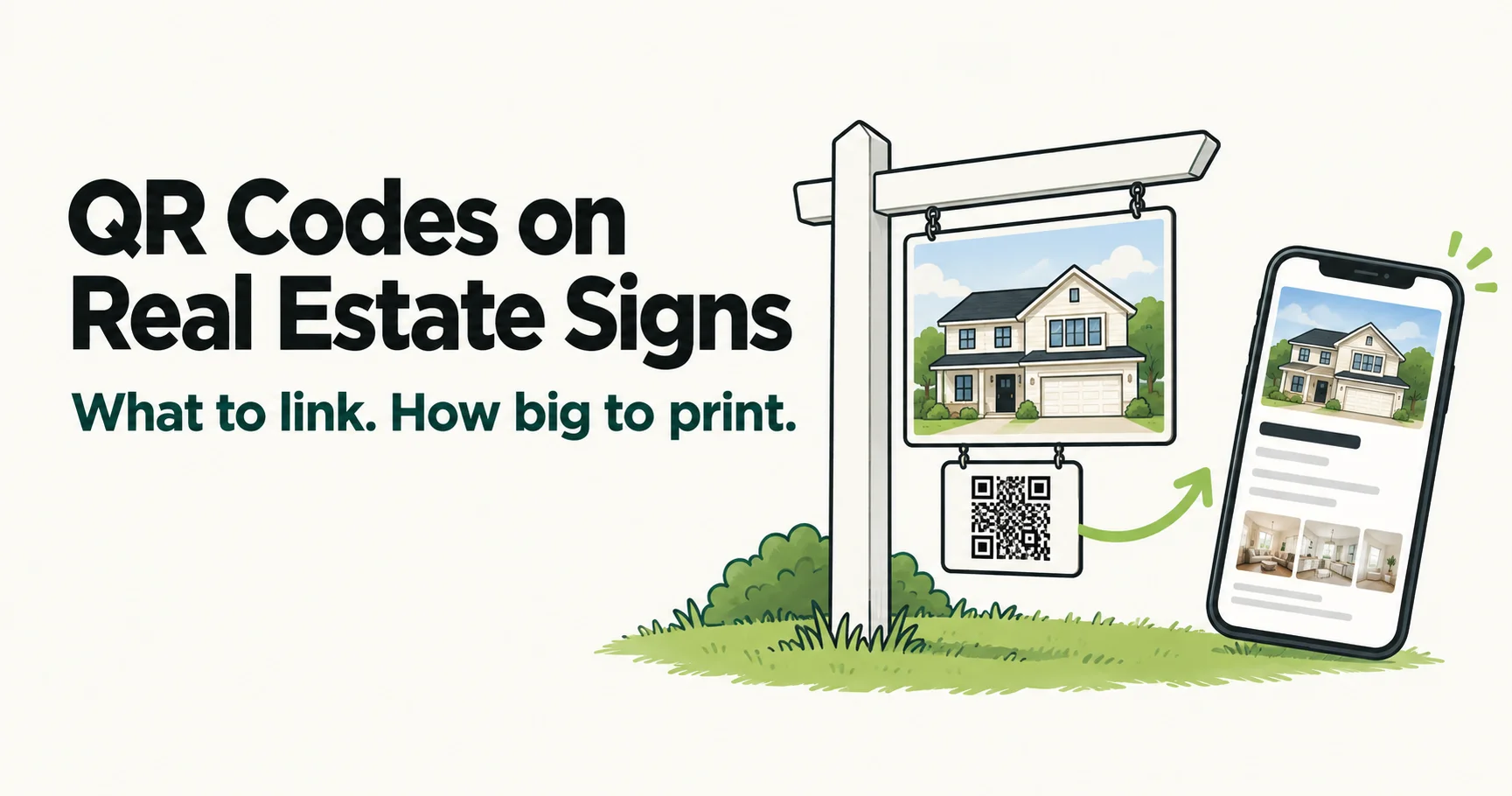
A QR code on a real estate sign should open the listing itself, in the phone's browser, in a single tap — and it should be a dynamic code, because the sign outlasts the price, the status and often the listing. Everything else about sign codes follows from those 2 choices. What the scan opens decides whether the person on the pavement keeps reading, and what the code holds decides how far away they can stand and still scan it.
TL;DR: Point the code at the listing, not at a form or a portal page. Use a dynamic code, so the printed pattern holds a short link and the file behind it can be replaced when the price changes or the house sells. In a simulated test of a 20 cm code at error correction level H, a 24-character short link still decoded at 4 m, while a static code holding an 84-character Zillow address stopped at 2 m.
What the code on a sign should open
A sign's code usually opens 1 of 3 things, and they serve different people.
The listing itself. Photos, price, rooms and floor plan: the document the sign is advertising, open in the browser with nothing in front of it. This is what the passer-by came for. A thread on r/CasualUK asked why for sale signs don't have QR codes "so I can be nosy", and one reply described the mechanism exactly: a code on each sign, each with its own address, forwarding to that property's details. I have no count of it, but curiosity is probably most of the traffic a sign gets. Neighbours, dog walkers, people who are not buying this year. Some of them will be next year.
A portal page. The Zillow or MLS listing. It is complete and it costs nothing, but it is not yours: the layout, what else the page shows, and what happens to it once the property sells are the portal's decisions. A portal address is also long, which matters more than it sounds, and the next section puts numbers on it.
A form. A page that asks for a name and an email, or for a text message, before it shows much. The case for it is put plainly by the-qrcode-generator.com: "You might ask them to enter their email to unlock more photos, RSVP for an upcoming open house, start a quick chat with you, or save the listing directly to their phone" (source). The case against is put just as plainly by Agent Text, which sells a text-message alternative: "A QR code that opens a web form asks the buyer to load, type, submit, and trust. That is four chances to lose them, and fake contact info is common even when they finish" (source). Both vendors sell a way of capturing the person who scans, so neither is neutral. The disagreement is still the useful part: every step between the scan and the listing loses the people who were only curious, and on a sign they are probably most of the people scanning.
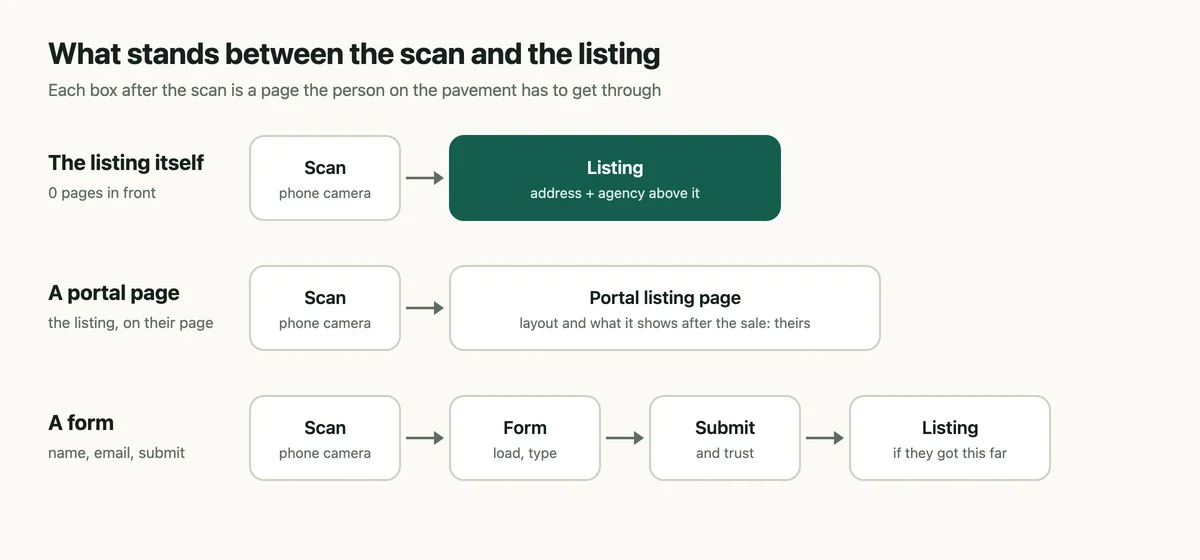
My position is to open the listing and put the ways to reach you under it, not in front of it. That is how the scan page on this site is laid out. QRCodeForPDF is a free, browser-based generator that turns a PDF or an audio file into a dynamic QR code with a hosted page; codes created without an account expire 7 days after creation, codes held in any account, free or paid, have no expiry date, and the file behind a printed code can be replaced without reprinting. On a listing code, the page shows the property address and the agency above the first page of the PDF, and the whole listing opens in a single tap. The scan page can carry up to 3 links under the listing on every plan — a virtual tour, the listing page on your own site, a calendar to book a viewing — and a contact card with a Save contact button is Pro. The real estate QR code page shows the result as a buyer sees it before you create anything.
How far away a sign's code still scans
The usual rule is 10 to 1: a code should be at least a tenth as wide as the distance it will be scanned from (Uniqode's size guide). That puts a 20 cm yard-sign code at 2 m. What the rule leaves out is that the camera does not resolve the code, it resolves each module, the small square inside it, and the number of modules depends on how long the address inside the code is. A static code has to hold the full listing address; a dynamic code holds only its short link.
To put numbers on that, I created 2 codes with this site's own encoder and ran them through a simulated phone camera. The setup: a phone held upright, the main camera's 26 mm-equivalent lens (a 49.6° horizontal field of view), analysis frames 1,440 pixels wide, no digital zoom, with lens blur, sensor noise and JPEG compression added. Each distance was tried 10 times with different noise and positions, and counted as readable when at least 8 of the 10 decoded under OpenCV's QR detectors. A phone's own decoder is better than OpenCV's and many zoom in on a small code, so treat the distances as a floor. The comparison between the codes is what the test is for.
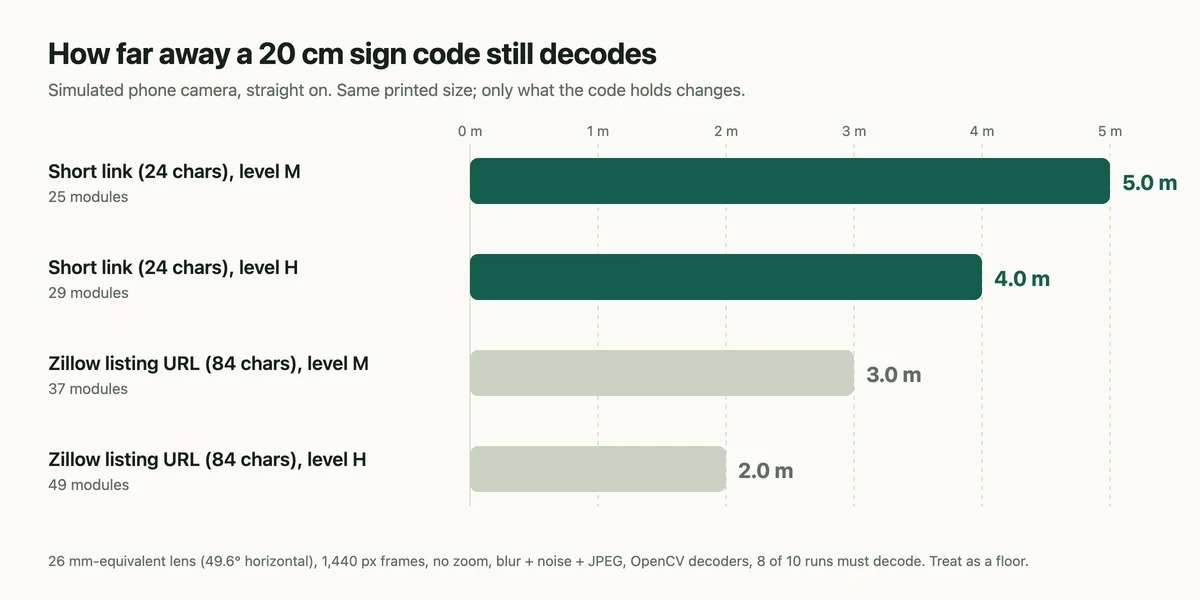
| What the code holds | Error correction | Modules across | 20 cm, straight on | 20 cm, 35° to the side | 10 cm, straight on |
|---|---|---|---|---|---|
| A 24-character short link | M | 25 | 5.0 m | 4.0 m | 2.5 m |
| A 24-character short link | H | 29 | 4.0 m | 3.5 m | 2.0 m |
| An 84-character Zillow listing address | M | 37 | 3.0 m | 2.5 m | 1.5 m |
| An 84-character Zillow listing address | H | 49 | 2.0 m | 2.0 m | 1.0 m |
At 20 cm and level H, the short-link code decoded from 4 m and the Zillow-address code from 2 m, so the short link doubled the distance on the same sign. The 10-to-1 rule turns out to describe a code holding a long static address, and it is too cautious for a short link, which is most of why sizing advice for signs disagrees with itself. A code created on this site always encodes a 24-character short link, so it is 25 modules across at level M and 29 at level H, whatever the listing PDF weighs. Contrast, the quiet zone and a blurred export are the other things that keep a printed code from scanning, and QR code not scanning? goes through each of them with numbers.
The table also shows what error correction costs. Level H lets a code survive about 30% damage (Wikipedia), which is why the real estate page here suggests it for a sign that stands in rain and sun for months. It also adds modules: at 20 cm the short link read from 5 m at level M and from 4 m at level H. On a sign that is worth giving up. A code that has faded or been scuffed past what level M can rebuild does not scan from any distance.
A standard sign rider is 6 by 24 inches (Lowen Sign's steel QR rider), which leaves room for a code about 12 cm wide once its margin is kept. In the simulation the range scaled with the code's width, 20 cm reading from 4 m and 10 cm from 2 m for the short link at level H, so a 12 cm rider code holding a short link should read from about 2.4 m, and one holding a long portal address from about 1.2 m. On a rider, the short link is the difference between a code people scan from the pavement and one they have to walk up the lawn for.
A rider, the panel, or a sticker
Where the code goes decides what can happen to it later.
Printed into the sign panel, the code is permanent. A static code on a panel points at 1 listing for the life of the panel, and when that property sells, every panel printed with it points at a sold listing. A dynamic code on the same panel can open the next property.
On a rider, the code is a separate panel that hangs from the sign frame, and a brokerage can keep a stack of generic "scan for photos and price" riders. That only works if the code on them is dynamic: a static rider code is tied to whatever address was printed into it.
On a sticker, the code is the cheapest to add to a sign that already exists, and it is the easiest for a stranger to copy, which is the next problem.
A sign is the easiest place to put a fake code
In January 2022 the FBI's Internet Crime Complaint Center warned that criminals tamper with physical QR codes by placing a sticker over the original, and told people to check the web address after scanning (IC3). The warning was about payment pages, but a yard sign fits the description better than most places: it stands unattended for weeks, in a spot a stranger can reach at night, advertising something people are ready to act on.
Phone cameras show the address before they open it, which is the check the FBI describes. A code created here always opens qrpdf.link, and the page it lands on shows the property address and the agency above the listing, so a buyer can see whose document it is before opening it. The other half of the check belongs to the agent: when you visit a listing, look at the sign's code from a step away. A sticker placed over the original shows at that distance.
The page a sign opens is advertising too
In New Jersey, N.J.A.C. 11:5-6.1(b) requires all advertising by a licensed broker to include the broker's regular business name (Cornell LII). The same rule has separate requirements for webpages. Whether the page a sign's code opens counts as advertising under it is a question for your brokerage, not for me, but a page that shows the agency's name above the listing is on the right side of it either way. I could not find a federal rule about QR codes on signs; the rules that matter are your state's advertising regulations and your MLS's.
A seller listing their own house is not a licensee, so a rule like New Jersey's does not bind a for sale by owner sign. The tampering risk and the size limits apply all the same.
When the price changes, and after the house sells
A sign stands for months, and what the listing says changes under it: price reduced, under offer, sold. Replacing the PDF behind a printed code is free on every plan, and every earlier version is kept, so the same sign opens the current listing from the next scan. When the property sells, the sign does not have to go in the bin: replace the listing with the next property, change the address above it, and the same printed code opens the new one.
Because a sign outlives most free trials, it is worth knowing what a provider does to a code when a trial or plan ends before the sign goes up; do QR codes expire? has the policies of 6 generators with their sources. For the difference between a static and a dynamic code in more detail, see how QR codes work.
Each code also counts its scans by day, so a code per sign tells you which sign is working, and gives you something to show a seller the week after it goes up. Country, city and device come with a paid plan. Nothing identifies the person who scanned.
What this site does not do
Each code opens a single PDF: it cannot show several properties, and this site does not build sign-in forms or lead-capture gates. For a set of properties, create a code for each, or put them in a single brochure.
The real estate page here opened on 2026-09-21, so I have no scan data from real signs yet; the distances in this article come from the simulation, not from a street. If you print a sign with a code from here, the scan count on your dashboard will know more by next month than this article does. Create the code for your listing, put the PDF behind it, and scan a test print from where people will stand before the sign maker runs the batch.